Consciousness is a phenomenon that we examine through various research and scientific perspectives.
Consciousness Research Association
Consciousness Beyond Matter – International Scientific Symposium in Gdańsk
On 28 August 2026, the international scientific symposium “Consciousness Beyond Matter” (Re-Thinking Consciousness) took place at the University of Gdańsk as part of the Euro-Asian Scientific Congress on Mental Health.


The event focused on one of the most important questions in contemporary science: Is consciousness exclusively a product of brain activity, or could it extend beyond the biological processes we currently understand?
The opening keynote address was delivered by Dr Pim van Lommel, a Dutch cardiologist and author of influential publications on near-death experiences (NDEs). His longstanding interest in the experiences reported by patients following cardiac arrest has contributed to the international debate on the nature of consciousness and its relationship with brain function.
Dr Jeffrey Long, a physician and founder of the Near Death Experience Research Foundation (NDERF), also took part in the symposium. He is widely known for collecting and analysing accounts from people who have experienced NDEs. Together with other invited experts and panelists, he contributed to an interdisciplinary discussion on the boundaries of current scientific knowledge about consciousness.
Other invited experts included Dr Marieta Pehlivanova of the University of Virginia, Professor Kevin Nelson of the University of Kentucky, and Dr Michael Nahm of the Institute for Frontier Areas of Psychology and Mental Health (IGPP) in Freiburg, Germany. Their research represents a range of perspectives on near-death experiences, brain function, and broader questions concerning the nature of the human mind.
The discussions focused on NDE research, the brain mechanisms associated with unusual states of consciousness, accounts from individuals following cardiac arrest, and the question of whether current scientific models fully explain subjective human experience.
The symposium provided a platform for exchanging knowledge among specialists from different scientific disciplines and examining diverse hypotheses and interpretations. Particular attention was given to consciousness in the context of extraordinary experiences occurring at the boundaries of life and death—experiences that remain the subject of ongoing scientific investigation and debate.
“Consciousness Beyond Matter” (Re-Thinking Consciousness) is an invitation to challenge established models of thought, ask bold questions, and seek answers through research, evidence-based analysis, and interdisciplinary collaboration.
The symposium in Gdańsk offered an opportunity to engage in dialogue about one of science’s greatest unresolved questions: the nature of consciousness and its place in our understanding of human beings and reality.
Consciousness Research Association (CONREAS) supports international collaboration and the advancement of consciousness research, bringing together scientists, researchers, and individuals interested in expanding the boundaries of knowledge.
Re-Thinking Consciousness – new questions, new perspectives, and a shared search for answers.
Symposium: Re-thinking consciousness
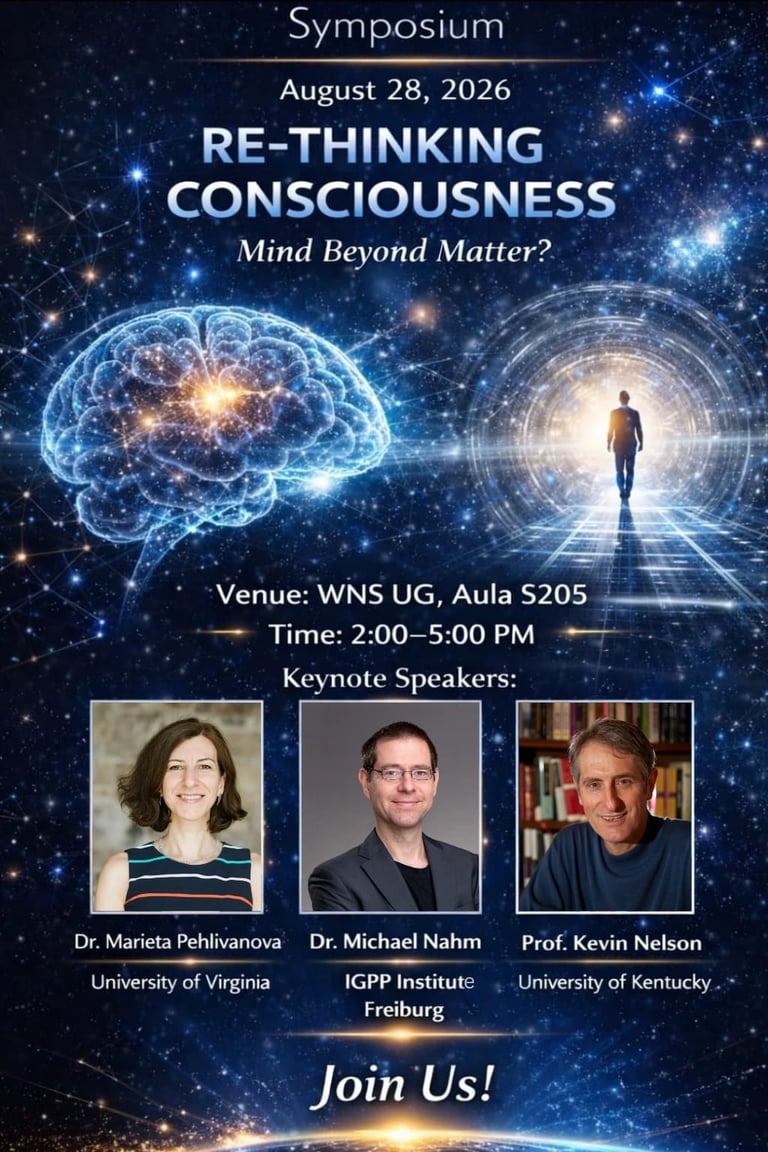
As part of the upcoming Euro-Asian Scientific Congress on Mental Health, we are pleased to host a specialized symposium dedicated to exploring the complex boundaries of cognitive science, neurology, and philosophy.
Join esteemed colleagues and international experts on August 28, 2026 (2:00–5:00 PM, Venue: WNS UG, Aula S205) to discuss the latest research pushing the frontiers of consciousness studies.
Keynote Presenters:
Dr. Marieta Pehlivanova (University of Virginia)
Dr. Michael Nahm (IGPP Institute Freiburg)
Prof. Kevin Nelson (University of Kentucky)
We look forward to your presence and contribution to this vital scientific dialogue.
Interview with Eben Alexander MD
See part of our conversation about consciousness with Eben Alexander MD
Conreas and HeartMath Institute


But is there evidence of dimensions of consciousness that go beyond the physical substrate, beyond material existence—dimensions that provide meaning to our lives? There are numerous credible testimonies and rigorous studies pointing in this direction. Our mission is to disseminate and deepen knowledge about such evidence and to promote interdisciplinary scientific research on this subject.
dr Zofia Weaver
Currently, there is no clear definition of consciousness. What scientists attempt to define as a concept containing distinct characteristics observable in studies of human populations is very limited due to unexplained phenomena that go far beyond the capabilities of research tools.
At the same time, a new stage in the development of science has begun, enabling the transfer of human consciousness into a robot, which would retain its traits and, after the biological body’s death, remain with loved ones to accompany them on their continued journey through life…
Consciousness requires further verification and expansion of its meaning and possibilities. Science is on the trail of proving the existence of a form of intelligence, independent of the material body, also known as consciousness, which can communicate with the world beyond the mind.
Effective research could contribute to a transformation in human identity.
Consciousness is increasingly regarded by many scientists as an integral and fundamental part of life, with our awareness and subjective experience being part of something greater.
Famous scientists in the search for truth


„I consider consciousness to be fundamental.”
Max Planck
„The universe increasingly resembles a great thought rather than a great machine.”
James Jeans
„…the world of our current consciousness is just one of many worlds of consciousness that exist, and... these other worlds must contain experiences that also have meaning for our lives...”
William James
„Consciousness must exist beyond the computable physics.”
Roger Penrose
Einstein, although he identified as an agnostic, often spoke about the mystery of the Universe and the role of a higher intelligence in its harmony.


„My religion is based on a humble admiration for the infinity of a higher Intelligence, which manifests in the details that we are able to comprehend with our weak and fragile minds."
Albert Einstein, interview for Georgea Sylvestra Vierecka in 1930


„That this most beautiful system of the Sun, planets, and comets could have arisen only through the guidance and dominion of a rational and powerful Being.”
Mathematical Principles of Natural Philosophy (1687).
Newton, the creator of the theory of gravity, also saw the involvement of a higher intelligence in the mechanisms of the Universe that he studied.
Planck, regarded as the father of quantum mechanics, openly acknowledged that he saw traces of a higher intelligence in nature.
„As a man who dedicated his entire life to the clearest science, the study of matter, I can say, based on the results of my research on atoms: Matter as such does not exist. All matter arises and endures only through force... We must accept that behind this force lies a conscious and intelligent mind.”
Max Planck during interview in 1944.


„The first sip from the cup of science leads to atheism, but at the bottom of the cup, God awaits.”
Quoted in various publications, including Encounters with Einstein (1969) by Werner Heisenberg.
The creator of the uncertainty principle, Heisenberg, suggested that the discoveries of science may be manifestations of a higher intelligence, incomprehensible to us.


Flew, initially known as an atheist, later in his life began to emphasize that the very structure of the Universe might point to the existence of a higher intelligence.
„What we have discovered is that God is a great Mathematician... nature points to a higher intelligence, to something that goes beyond what we are able to comprehend.”
Book: There Is a God: How the World's Most Notorious Atheist Changed His Mind


„At our first encounter with the mystery of the cosmos, we have a sense of the presence of something Divine. The more we discover, the more we realize how little we know.”
Arthur EddingtonThe Nature of the Physical World (1928).
The renowned astrophysicist and popularizer of Einstein's theories, Eddington, spoke of the mystery of existence in terms of a "higher intelligence."


Contact us
Consciousness Research Association
The Association for Consciousness Research
Contact
contact@conreas.com
© 2024. All rights reserved.