Lucid Dying
Death is not an event, but a continuum. Discover the research into 'RED' (Recalled Experience of Death) and the scientific discoveries currently revolutionizing our understanding of life and mortality.
Zofia Weaver
1/27/20269 min read
If you look up Sam Parnia’s academic content online you will find his entry on New York University page listing his books and articles in reputable journals, many co-authored by him dealing not just with NDEs but with resuscitation, cardiac arrest, hypothermia, asthma, various aspects of covid; he is an active researcher and doctor.
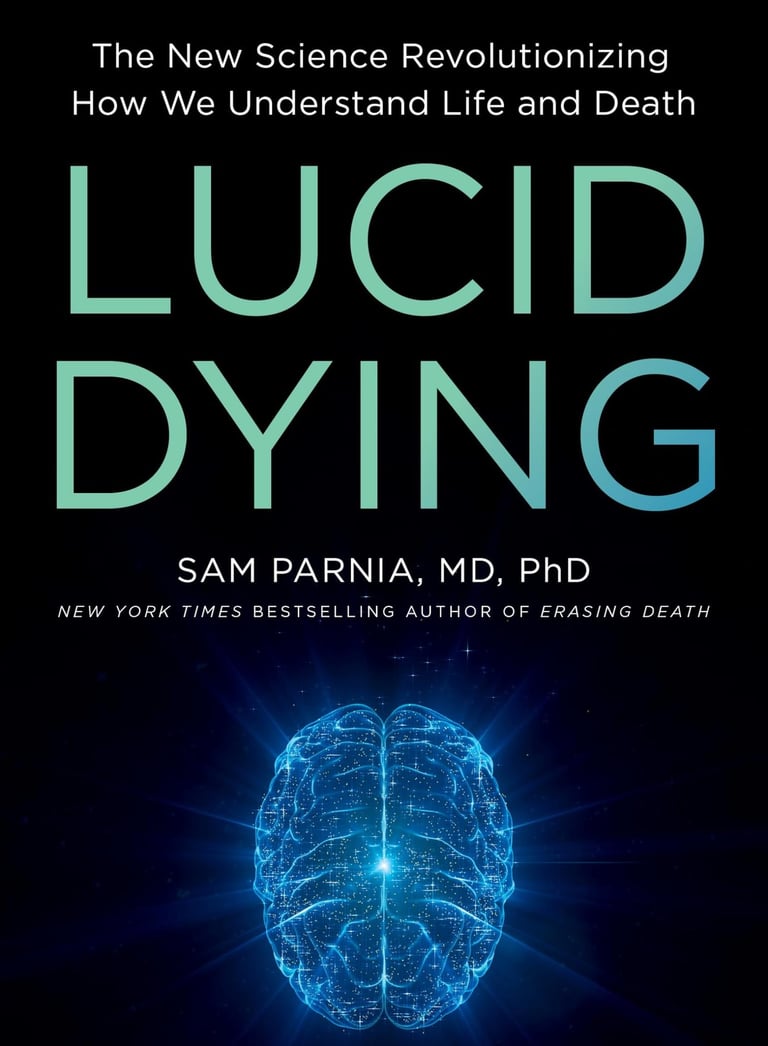
An overview of Sam Parnia’s The new science revolutionizing how we understand life and death: Lucid Dying, Hachette Books 2024
Death is the only certainty, and basic questions and answers relating to it are rooted in tradition. However, our view of death is fundamentally wrong, because the paradigm no longer exists. It is not a binary event, and the question is: does consciousness go on? These changes in the paradigm are ignored by mainstream science and society, but this is no longer just philosophical or theological speculation. Technology now lets us observe the “crossing over” process. The science around dying has evolved in the last decades, making the previous notions of death and post mortem outdated. Lucid Dying aims to give a synthesis of the most important scientific discoveries.
As a first-year medical student, in 1994, Sam Parnia witnessed death, when doctors were trying to resuscitate a patient; this, and his father’s vegetative state (and the question whether his father was still there?) decided his choice of career, specialising in intensive (critical) care medicine, cardiac arrest resuscitation and critical brain injury. We now know that biological and mental processes do not end absolutely with death and neither does consciousness; there is a liminal grey zone Parnia refers to as RED – recalled experience of death, which he prefers to the term NDE (arbitrary and imprecise). There is no doubt that these experiences happen.
The first chapter of Lucid Dying is called “The brain in the bucket” and describes the 2018 conference presentation for leading scientists and lawyers of the NIH (National Institute of Health). A team of scientists restored life to the brains of dead pigs that had been decapitated, 4 hours after they had been killed, collected from an ordinary abbatoir. It turned out that, kept in a special nutrient solution for blood perfusion, these brains returned to life up to 14 or even 36 hours after death. They were fully functional, with normal biological, chemical and electrical activity. Their brainwaves were flat because of a special drug applied to ensure that there was no suffering that would come with having awareness without functioning senses. These were not just cells but whole brains that were alive and could be restored, but return of consciousness was blocked by an anaesthetic solution.
This kills the scientific dogma that brain cells deprived of oxygen die in minutes, and shows that death is reversible. Research continues into reviving whole animals and by 2022 death of the whole animal can be reversed. News of this discovery was purposely downplayed for the media to avoid sensationalist reporting; scientists informed the media not about a living brain in a bucket but of a cellularly active brain.
Death is not a binary event, it is a continuum, and when (not if) we can revive people they will tell us what happens. Definitions of death have changed over decades: since the 1960s, when CPR (cardiopulmonary resuscitation) methodology became common, the heart that stops beating can be restarted. However, deep coma research shows that people kept artificially alive would die after a while (weeks); post mortems show that their brains liquefy; they had died some time earlier, because they were not breathing, but the technology appeared to keep them alive.
The 1968 brain death definition assumed that oxygen deprivation kills the brain, but now we know that it goes into hibernation; we like yes/no answers to being dead or alive but that is not true, death is not irreversible. The pigs were dead, but cells go into something like a hibernation state after death. By 2021 work was going on on a new definition of death, because there is no absolute biological line; it’s a medical condition.
Parnia then goes on to summarise well-know historical evidence, including Plato’s Er and evidence from the 19th century. However, the story of NDE research begins in the 1950s and 1960s when CPR and life support systems became effective. In 1975 Raymond Moody published Life after life, based on stories told by some of the resuscitated people; their main features consistently were: no words to describe the experience; OBE (out of the body experience); peace; tunnel; meeting others; a being or beings of light; life review, reaching a borderline, return to the body; long-lasting positive effect: altruism and no fear of death. ALSO knowledge of events acquired paranormally
As explained by Bruce Greyson, a Near Death Experience is any situation where a person is thought likely to die without medical intervention. There are lots of experiences, not necessarily close to death, under that label, and many publications use the term arbitrarily; it is not a scientific term. In science „near to death” is biologically objective and precise; your blood pressure drops to a dangerous level, you lose consciousness, you go into a deep coma - BUT you may have an intense internal experience. It is an extreme medical shock biologically, but it is a process so resuscitation is possible. The term „clinical death” is not compatible with current biological and medical knowledge.
A very important development took place in 2013: Jimo Borjigin, a neuroscientist, discovered high rate brain activity (indicating supraconscious state) in dead rats with no heart beat, up to 5 mins after the heart stopped. By 2023 such spikes have been confirmed in people by many researchers. This was widely interpreted as an explanation for NDEs that discredited the reports of NDE experiences, showing them to be a „trick of the dying brain”. Sam Parnia asks: what would be the evolutionary purpose of this? Consciousness should fade, not run at coordinated gamma waves, high frequency associated with superlucidity.
In 2023 AWARE II study was published in the journal Resuscitation. It was much larger and more sophisticated than AWARE I (2008-2012); it involved more than 500 patients in 25 medical facilities, patients who’d undergone resuscitation (CPR) with attached monitors.10% of them survived, there was also a „control” group made up of people with self-reported memories. One in five in the AWARE II study had a RED: separation from the body, observing events, life review, sense of going home, then return to the body.
Analysis of their narratives involved using grounded theory, a qualitative research method using the latest technology to explore people’s experiences, beliefs and attitudes, not relying on subjective labelling that reflects personal views. The method allows analysis of non-numerical data, words, images, narratives. About 40 main universal themes were identified in addition to those identified by Moody. These experiences were different from imaginary and hallucinatory experiences. Ca 40% showed spikes in brain activity after flatlining. According to Parnia, this is evidence that the experience can take place during death, not before or after. The flurry of brain activity during the CPR is a biological sign of NDE, but further studies are needed and justified.
In 1997 Parnia worked with Peter Fenwick, putting images high up near the ceiling in hospital emergency wards that could not be seen from below, facing upwards. The assumption was that the dying patients might report seeing them, but that was not the case, and there were too many simple assumptions in that study. But the study also produced many letters from patients. During the years 2008-2012 the study AWARE I was organised in 15 hospitals, in emergency and critical care units, but the majority of people died. Some recollections were collected but not all were experiences of death, some were dreams.
However, even in AWARE I, 9% had a RED (recalled experience of death) and two people reported being aware of things going on around them, seeing them from above. One verified case showed that the period of conscious awareness lasted at least 3 to 5 minutes while the heart was not beating. Unfortunately the experiencers were not in the rooms where there were pictures facing upwards on shelves. Parnia quotes the case reported by Van Lommel, in Lancet, 2001, of a patient in a coma knowing what the nurse did with his dentures. There are many other cases, and the Natural Language Project that was used has the tools to analyse narratives and derive meaning, comparing them to dream testimonies and hallucinations; thousands of reports have now been analysed.
Parnia claims that negative experiences reported by some patients were just frightening memories when people were not fully awake; such reports are familiar to intensive care professionals and known as Intensive Care Unit delirium. AWARE II demonstrates that terrifying memories are not the same as the RED narratives, they are memories formed when people were waking up from coma in hospital (ICU delusions) (p. 290).
In spite of oxygen deprivation the brain is robust; it can go into hibernation, a grey zone, and can return to action by itself. When blood pressure collapses, lifesaving hormones such as adrenaline are released. Dormant parts of the brain that are better equipped to deal with threat are activated; there is disinhibition, a release of the brakes on processes aimed at saving life and concentration on survival, a fight-or-flight response. There is activation of dormant brain pathways that give access to hidden consciousness, suggesting it is potentially far vaster than what we can ordinarily perceive. Among other examples, Parnia quotes that of Tony Cicoria, who after being struck by lightning developed great musical abilities; it means opening to superhuman abilities through dysfunction. But this does not go on limitlessly.
Dying people have a slowing of brain waves, flattening within seconds, then a surge before being lost again. This is a turning point of brain dysfunction – inhibition of everyday functions when dealing with a new situation. This was revealed by AWARE II and Parnia regards it as an explanation for the spikes in brainwaves that give access to hidden capabilities, new dimensions of reality. This might explain the life review, the inner hyperconscious and hyperlucid experience. As dysfunction worsens, the optimal turning point is passed, and there is not much recall. It is not a hallucinatory state but real experience that emerges with death. Why? What state of reality are we being prepared for?
Parnia follows this with a description of the NDE experience and its main ingredients.
As a result of 2019 conference of leading experts from humanities, emergency medicine, psychiatry etc., „Guidelines and standards for the study of death and recalled experience of death” were published in the Annals of the NY Academy of Sciences. There was a consensus statement, definition, terminology and research framework, and a recommendation to use the term RED (recalled experience of death) for being in the zone of death rather than close to it.
There is plenty of evidence for RED providing access to expanding knowledge and insights, a vast, more lucid consciousness. At the same time the brains were flatlining and then there was a sudden surge of waves. There was no blood flow and no oxygen, needed for dreams or hallucinations. Results of AWARE II are in line with millions of reports of RED.
Quoting Parnia: „We do not dismiss the reality of what people have recalled. We agree that they experience a new dimension of reality in death. We also do not think the finding of brain electrical markers of hyperconsciousness means the brain is producing the experience. On the contrary, it means the mind and consciousness, tethered to the brain in death, are interacting and modulating the brain.” – the ancient mind-body problem
Parnia quotes many reliable NDE reports: vastly expanded consciousness, disinhibition; a number of reports from medical people, one with a recurring heart problem who always gets the same experience of elation and expanded consciousness. Impossible to recall, after the experience the gate is shut. RED does not fit in with any traditional views of what happens at death: expansion of consciousness, lucidity, bird’s eye view, knowing everything, selfhood is not the body, „ ... consciousness like a flux of energy is able to pervade through others” (p. 145). All this happens when oxygen to the brain is restricted.
Parnia devotes a whole chapter to examining in detail accounts of the life review, the presence of an entity, the hierarchy of beings and the whole value system which seems consistent and independent of cultural beliefs. The experience is ineffable, inexpressible, conveying absolute universal love and peace; is it part of evolving? He goes on to talk about the limitations of the brain and the senses, using the popular metaphors of Plato’s cave and Flatland dwellers and, while not using the word „reincarnation”, implies that people are aware of past lives, that there is continuation, an ascending series of human lives (p. 200).
There is a brief account of the history of brain research, a mention of people leading normal lives with hardly any brain (indicating that the brain mediates but does not produce consciousness). Trying to explain consciousness by more complex connections in the brain does not explain how chemical and electrical processes give rise to consciousness; there are many theories, but none of those that see consciousness as an emergent property have supporting scientific data, and the sheer number of theories means that we are nowhere close to a scientific explanation. Hameroff and Penrose postulate that consciousness is a quantum physics process taking place in microtubules, but that just moves the problem from cell networks to tubes inside cells. As for David Chalmers’ „hard problem” of consciousness, body-mind relationships are all hard problems.
There is also a discussion of the philosophy of Bahram Elahi which suggests that the self is a type of matter too subtle tobe measured with today’s tools. Sam Parnia finds very convincing but it is not directly related to the subject of NDE/RED (p. 238).
Towards the end of the book, Parnia comments on the first AWARE study and sees it as naive: „In the grey zone of death, the concept of ‘seeing’ or ‘hearing’ is not literal ... they do not use the apparatus of the sensory system.” (p. 284) Instead, people undergoing brain monitoring in cardiac arrest are „... liberated from their body... yet have a hyperconscious awareness of all events around and beyond themselves all at once and in 360 degrees. They realise that their real self is their consciousness, not the body. ...consciousness and selfhood feels like a field of energy... one that can penetrate the thoughts of others and objects.” (p. 286). In the recalled experience of death what matters is the value system, value of actions and intentions (p. 287), a „universal moral and ethical standard” (p. 299). Death seems to be the first step in a larger process ... „consciousness can continue to exist beyond death, in line with our emerging scientific data” (p. 315).
Consciousness Research Association
The Association for Consciousness Research
Contact
contact@conreas.com
© 2024. All rights reserved.